Women Cash Assistance Schemes in India 2026: State List
Almost every major state in India now runs a monthly cash scheme for women, and Haryana is no exception. Since 25 September 2025, the state has been rolling out the Deen Dayal Lado Lakshmi Yojana, promising ₹2,100 a month to eligible women through Direct Benefit Transfer. On paper it reads like a clean, generous welfare promise. In practice, whether that money actually reaches a woman’s bank account depends on a chain of small administrative details that most applicants never hear about until a payment goes missing.
If you manage a household’s paperwork through the Haryana Family ID, you already know the system is unforgiving about accuracy. The same logic that decides your ration card category and your Ayushman cover also decides your eligibility for Lado Lakshmi. That is why understanding how these women-centric schemes work across India is genuinely useful, not just for comparison, but because the mechanics that trip people up are nearly identical from one state to the next.
Why Haryana’s Family ID Sits at the Centre of It All
In Haryana, you cannot treat the Lado Lakshmi Yojana as a standalone form you fill once and forget. Eligibility is read directly from your Parivar Pehchan Patra. The verified annual income recorded against your Family ID is the figure that decides whether you fall inside the scheme’s cut-off, and the first phase of the rollout has been targeting women aged 23 and above from lower-income households, with the income ceiling revised upward in early 2026 to widen coverage.
That single link between your Family ID and your scheme eligibility is the most overlooked point of failure. A wrong income slab, an unverified member, or an Aadhaar number that is seeded with the bank but not mapped for DBT will quietly block the transfer even when your application shows “approved.” Fixing the data on your Family ID first is not optional admin work; it is the actual prerequisite for the money to move.
The Real Engine Behind Every Scheme: DBT and NPCI Mapping
Here is the part nobody explains clearly at the application counter. Aadhaar–bank seeding and NPCI DBT mapping are two different things, and a payment can fail on the second even when the first is complete.
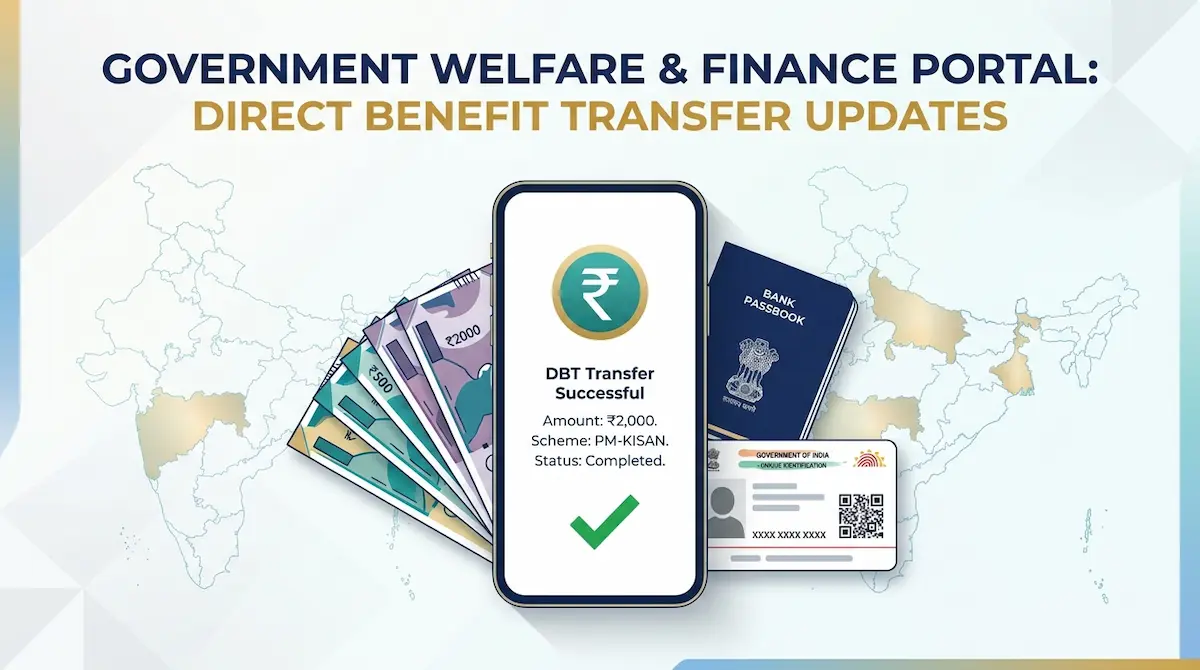
When a state treasury releases your monthly amount, the funds do not travel to your account number. They travel to whichever bank account the NPCI mapper has tagged to your Aadhaar for government payments. Most banks complete the basic Aadhaar seeding automatically when you open an account. The DBT mapping, telling the system that this specific account should receive scheme money, often needs you to walk into the branch and request it on the Aadhaar Seeding and DBT Linkage form.
This is precisely why a status that reads “disbursed” can still show a zero balance. The money was released; it simply had nowhere mapped to land. Every women’s cash scheme in the country runs on this same plumbing, so the fix is the same whether you are in Haryana, Maharashtra, or Madhya Pradesh.
How Maharashtra Built the Template Other States Now Follow
Maharashtra’s scheme is worth studying because it is the largest and most closely watched of its kind. The Ladki Bahin Yojana pays ₹1,500 a month to women aged 21 to 65 from families earning under ₹2.5 lakh a year, and it crossed roughly 1.75 crore active beneficiaries — a scale that exposed every weakness in the DBT process long before smaller states hit the same walls.
The biggest lesson from Maharashtra was about eKYC. When the state tied continued payments to Aadhaar-based eKYC, tens of lakhs of accounts were temporarily suspended, and a large share of those suspensions came down to a single misread declaration on the form rather than genuine ineligibility. Women who corrected their eKYC within the extended window had their pending installments released together. The takeaway for any state’s beneficiaries is blunt: an approved application is not a finished application until your eKYC and DBT mapping are both clean.
For Haryana applicants, that is a free preview of the problems Lado Lakshmi will face at scale. The states that learned from Maharashtra are the ones building eKYC verification and grievance redressal in from the start.
Read also:
A Quick Cross-Country Comparison
The headline amounts vary, but the structure rarely does. Madhya Pradesh’s Ladli Behna Yojana pays ₹1,250 a month and was, in many ways, the political blueprint the other states copied. Chhattisgarh’s Mahtari Vandana Yojana sits at ₹1,000 a month. Odisha’s Subhadra Yojana takes a different shape, paying an annual amount in installments rather than a flat monthly transfer.
What unites all of them is the eligibility logic: a residency requirement, an income ceiling, an age band, exclusions for income-tax filers and government employees, and mandatory Aadhaar-linked individual bank accounts. Joint accounts fail DBT in every one of these schemes for the same technical reason. Once you understand one scheme’s machinery, you effectively understand them all.
What a Haryana Beneficiary Should Actually Do
If you want the Lado Lakshmi amount to arrive without a fight, work through the chain in order rather than waiting for a problem to surface.
Start with your Family ID. Open it, confirm the recorded annual income matches reality, and if it has been verified into a higher slab than your actual earnings, file a correction with current proof before anything else. Next, confirm that the head of the family’s Aadhaar-linked mobile number is active, because every login and eKYC OTP routes to that number and nothing else.
Then handle the bank side. Check your Aadhaar bank-seeding status on the UIDAI portal, and if it shows inactive or unmapped, visit the branch and explicitly ask for DBT mapping, not just seeding. When the transfer narration eventually appears in your passbook, save the SMS as proof. And treat the application as free at every stage: no agent, no service centre, and no “fast-track” middleman is authorised to charge you for the form or the eKYC.
The Bottom Line
The amount a scheme advertises is the least interesting thing about it. ₹2,100 in Haryana, ₹1,500 in Maharashtra, ₹1,250 in Madhya Pradesh — none of it matters if the underlying data is wrong. The women who receive their money on time are not luckier; they are the ones whose Family ID, eKYC, and DBT mapping all line up. Get those three right, verify everything against the official state portal, and the scheme does exactly what it was designed to do.